

For lenders and forwarders managing high volumes of cases, the order of operations matters more than most people realize. Assigning cases before confirming lien status can oftentimes create workflow inefficiencies, costing both clients and service providers time and money. This can lead to strained vendor relationships, regulatory scrutiny, and significant reputational risk.
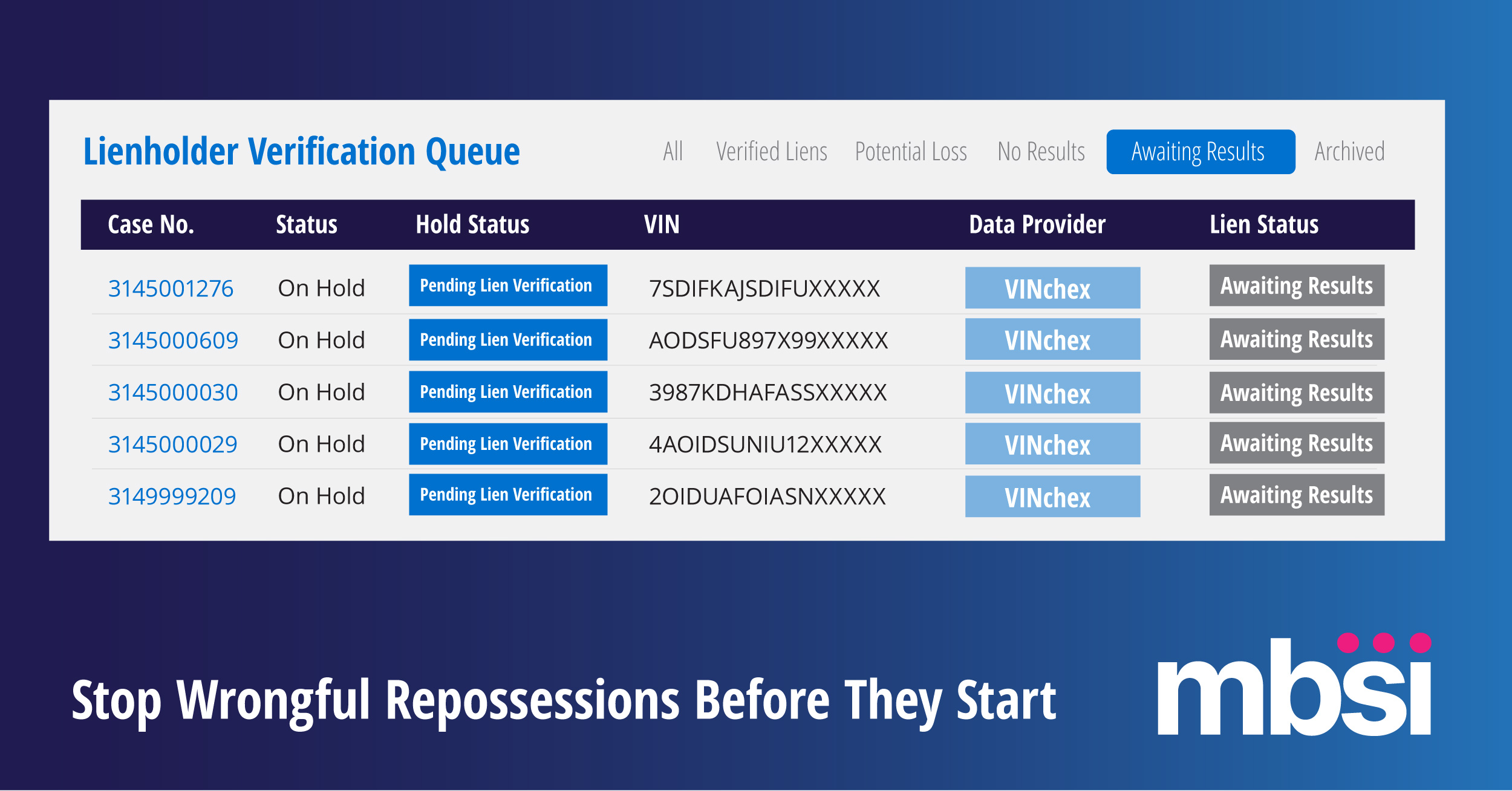
MBSi’s lien verification now gives lenders and forwarders (agencies, too) the ability to check lien status before a case is assigned to a service provider, turning a reactive, error-prone process into a proactive compliance checkpoint.
The traditional case assignment process looks something like this: a case is created, it’s assigned to a service provider, and lien verification happens somewhere down the line…if it happens at all. When a lien check eventually confirms lien loss, the case must be reversed. That means pulling the assignment, notifying the service provider, and wasting effort on both sides.
The downstream consequences compound quickly:
The risk isn’t hypothetical. Inadvertent repossessions carry real legal consequences for lenders, and they put service providers in an impossible position. Verifying lien status after the fact isn’t due diligence—it’s a liability.
MBSi’s lien verification changes the process. Instead of assigning cases and running lien verification ad hoc, lenders and forwarders can now run a lien check at case creation—before the case ever reaches a service provider.
That single shift in workflow delivers meaningful results:
When your vendors know that every case coming from you has been pre-verified, it changes the working relationship. You’re no longer a source of uncertainty. You’re a reliable partner.
This capability didn't start on a whiteboard: it started with a client. In November 2025, the client came to us with a specific ask: they wanted the ability to verify lien status before cases were ever assigned to service providers... six months later, the feature was live. That turnaround — from client conversation in November 2025 to launch by end of May 2026 — reflects MBSi’s collaborative approach towards product development to build features and solutions that solve challenges our clients actually face.
Manually tracking lien status across a high volume of cases is time-consuming and error-prone. MBSi’s Lien Verification solution was built to solve that. Rather than relying on manual checks, clients can automate the verification process entirely and confirm who holds the active lien on a case.
Here’s what that looks like in practice:
The result is a process that’s faster, more accurate, and far less exposed to the compliance risks that come with unverified recoveries.
The repossession workflow has always carried risk, but much of that risk is manageable when the right checks happen at the right time. Lien verification isn’t a nice-to-have. For lenders and forwarders operating at scale, it’s a fundamental part of doing business responsibly.
By moving lien verification to the front of the workflow—before assignment, before a vendor ever touches the case—MBSi’s lien verification helps you protect your organization, your vendors, and the consumers you serve. You’re not just reducing operational friction. You’re building a recovery process that holds up under scrutiny.
Ready to see how it works in your environment? Learn more about MBSi’s lien verification or drop us a line at sales@mbsicorp.com to schedule a demo.


Copyright © 2026, MBSi Corp. All rights reserved.
MBSi is proud to be a member of the Agero family of companies and pleased to connect our lender partners to the many services and products available through Agero.


Copyright © 2025, MBSi Corp. All rights reserved.
MBSi is proud to be a member of the Agero family of companies and pleased to connect our lender partners to the many services and products available through Agero.